Lord Michael Gove and Chand Chudasama discuss how to grow the UK economy
Lord Michael Gove and Chand Chudasama, Chairman at Price Bailey, debated how the UK economy can accelerate growth in
Press Release Disclaimer: This is a press release distributed through the XPR Media network. It has not been independently verified by our newsroom.
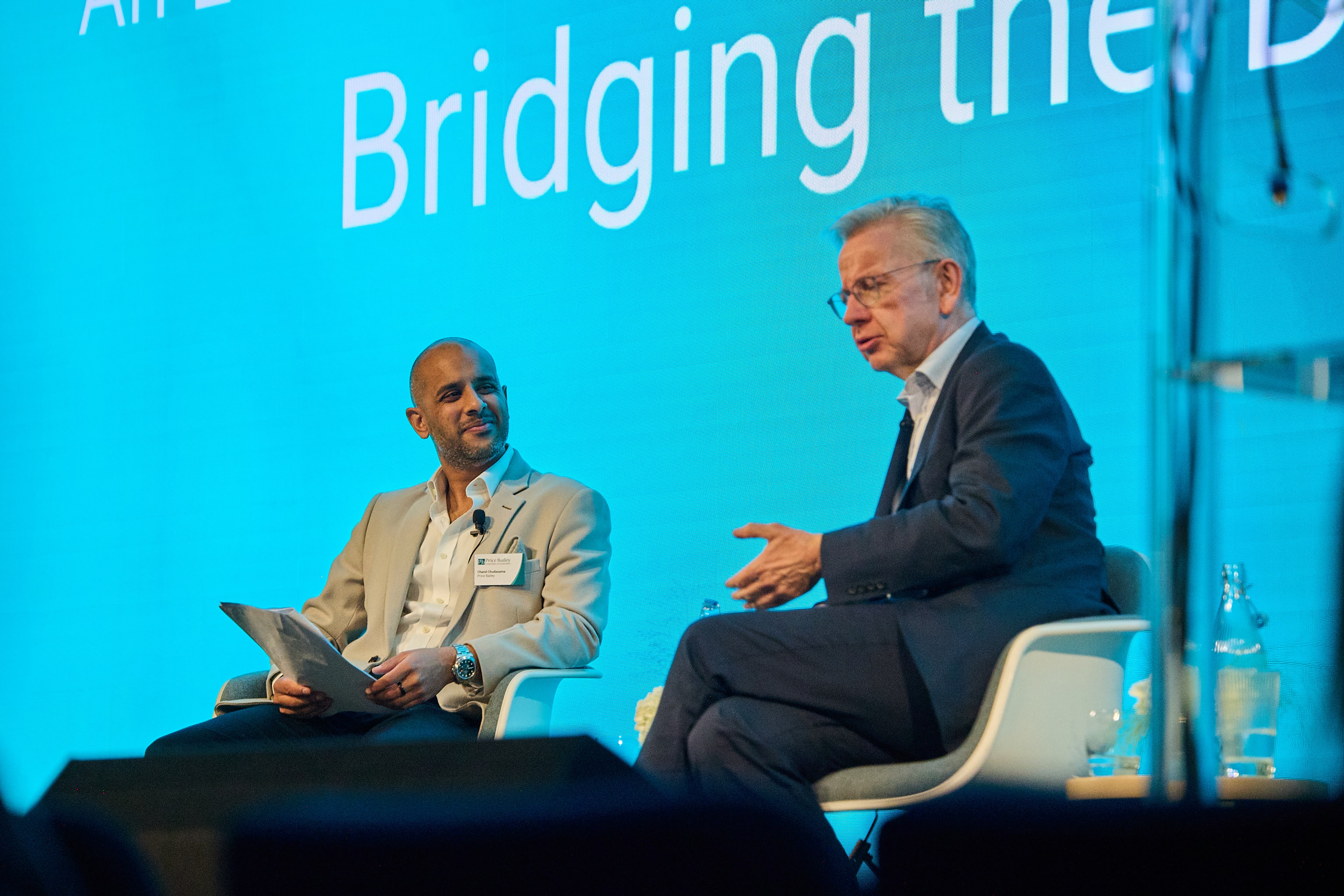

Lord Michael Gove and Chand Chudasama, Chairman at Price Bailey, debated how the UK economy can accelerate growth in front of a live audience in London
LONDON, UNITED KINGDOM, October 15, 2026 /EINPresswire.com/ — Price Bailey Chairman Chand Chudasama challenges Lord Michael Gove on Britain’s economic future in front of hundreds of London business leaders
Taxation, economic growth, artificial intelligence and the widening divide between business and Westminster dominated a high-profile debate between Price Bailey Chairman Chand Chudasama and former Cabinet minister Lord Michael Gove in London.
Chand Chudasama, Chairman of leading UK accountancy and business advisory firm Price Bailey, went head-to-head with former Cabinet minister Lord Michael Gove in a wide-ranging debate about the future of the British economy, challenging the former Secretary of State on taxation, government policy, regulation and the obstacles facing British entrepreneurs.
The discussion took place before an audience of approximately 400 business owners, investors, bankers, professional advisers and senior executives at the Institution of Engineering and Technology (IET) in London.
The event, entitled Bridging the Divide was organised by Price Bailey to explore the findings of its latest MPs and Business Leaders Survey 2026, which examined the economic priorities and attitudes of more than 100 Members of Parliament and over 500 UK business leaders.
The research exposed significant differences between the political establishment and the business community, particularly in attitudes towards taxation, commercial priorities and the policies required to stimulate investment.
Against this backdrop, Chudasama led a searching discussion with Lord Gove, one of the most prominent and influential figures in British politics over the past two decades, who served in several senior Cabinet positions under successive Conservative prime ministers.
Rather than a conventional political interview, the conversation explored the practical consequences of government decisions for entrepreneurs, employers and investors, and questioned whether Britain’s political institutions adequately understand the realities of running a business.
A central theme of the debate was whether successive governments have created an environment that encourages businesses to invest, recruit and expand.
Chudasama pressed Lord Gove on the relationship between taxation and economic growth, exploring whether the UK’s increasingly complex and burdensome tax environment risks discouraging the very individuals responsible for creating jobs and generating wealth.
Gove argued that high taxation could undermine entrepreneurship and investment, while suggesting that the Treasury’s institutional preference for controlling expenditure had historically limited the government’s willingness to make investments capable of delivering longer-term economic benefits.
He proposed a stronger institutional counterweight to the Treasury, with an explicit responsibility for championing economic growth.
The debate also examined the tension between political priorities and commercial realities, including the difficulties businesses encounter when attempting to plan investment against a backdrop of regulatory change, rising employment costs and economic uncertainty.
Chudasama, who is a leading company valuer and M&A advisor, brought a commercial perspective to the conversation, asking what policymakers could do differently to restore business confidence.
Chudasama said: “Britain does not have a shortage of entrepreneurial ambition. We have extraordinary businesses, talented people and investors who want to build something successful. The question is whether our political and economic environment genuinely rewards that ambition.
“What struck me about our research was the distance between how politicians and business leaders see the same challenges. Both want growth, prosperity and opportunity, but there are fundamental differences in how they believe those outcomes can be achieved.
“We wanted to challenge those differences openly. If policymakers are serious about growth, they need to understand what actually influences an entrepreneur’s decision to employ another person, invest another million pounds or establish their next business in Britain.”
The discussion moved beyond taxation to the wider competitiveness of the British economy.
Lord Gove identified high industrial energy prices, increasing employment costs and regulatory uncertainty as significant constraints on investment and growth.
He questioned whether some regulatory requirements had become disproportionately focused on process rather than practical outcomes, citing environmental requirements associated with the Hinkley Point C nuclear development as an example.
The exchange reflected a broader concern emerging from Price Bailey’s research: that businesses increasingly face difficulties making long-term decisions when the regulatory and economic environment remains unpredictable.
The debate also considered Britain’s approach to food security, agricultural policy and changes to Inheritance Tax affecting farming businesses.
Gove argued that domestic food production should be regarded as a national security consideration, while recognising the need to understand the consequences of major policy changes for agricultural businesses.
One of the most forward-looking exchanges concerned artificial intelligence and its potential to reshape the labour market.
The discussion explored whether Britain is adequately preparing for technological disruption, particularly among white-collar professions and the graduate employment market.
Lord Gove suggested that AI could have profound consequences for entry-level professional roles, traditionally an important pathway into careers in accountancy, law, financial services and other knowledge-based industries.
He also highlighted the difficulties facing younger generations, including student debt and housing affordability, and questioned whether political leadership was keeping pace with the speed of technological change.
For Chudasama, the debate raised questions extending well beyond the current economic cycle.
“AI has the potential to transform productivity, but it also forces us to rethink how people begin their careers and develop the skills that businesses will need in the future,” Chudasama said.
“We cannot talk about long-term growth without talking about the next generation. We need an economy in which young people can build careers, accumulate wealth and have the confidence to start businesses of their own.”
The evening opened with a presentation from Price Bailey Managing Director Martin Clapson, who introduced the findings of the firm’s research.
The survey highlighted areas of common ground between MPs and business leaders, particularly around skills, infrastructure and the importance of economic growth, but also revealed differences in their respective priorities.
Clapson outlined three trends emerging from Price Bailey’s work with businesses: slowing growth, increasingly cautious investment decisions and a sharper focus on productivity.
He also highlighted recurring concerns about taxation, regulation, skills shortages and the difficulties of planning with confidence.
The event formed part of Price Bailey’s wider commitment to bringing the experiences of privately owned businesses into national conversations about economic policy.
Chudasama concluded:
“Business leaders do not expect politicians to agree with them on everything, and politicians should not expect business leaders to accept every policy without challenge.
“What matters is having the confidence to debate difficult questions, test assumptions and recognise where the political and commercial worlds see things differently.
“Lord Gove has been at the centre of some of the most consequential decisions in modern British politics. Having the opportunity to challenge him directly, in front of hundreds of people who build, finance and advise British businesses, was an important part of that conversation.
“If Britain is to achieve sustained economic growth, the relationship between government and business must become more constructive, more informed and ultimately more ambitious.”
The Bridging the Divide event reinforced Price Bailey’s role in connecting business leaders, policymakers and advisers, and encouraging informed debate about the policies shaping the UK’s economic future.
Notes to editors
About Price Bailey
Price Bailey is a leading UK firm of chartered accountants and business advisers, providing audit, tax, corporate finance, accounting and strategic advisory services to privately owned businesses, entrepreneurs and organisations across the UK.
About the research
Price Bailey’s MPs and Business Leaders Survey 2026 compares the views of more than 100 Members of Parliament and over 500 business leaders, examining economic policy, taxation, business support and the outlook for British enterprise.
About the event
Bridging the Divide took place on 30 September 2026 at the Institution of Engineering and Technology in London, attended by approximately 400 guests.
Further information: www.pricebailey.co.uk
Lord Gove’s views expressed during the event are his own and do not necessarily represent those of Price Bailey.*
Eleanor Lodge
Price Bailey
Legal Disclaimer:
EIN Presswire provides this news content “as is” without warranty of any kind. We do not accept any responsibility or liability
for the accuracy, content, images, videos, licenses, completeness, legality, or reliability of the information contained in this
article. If you have any complaints or copyright issues related to this article, kindly contact the author above.

Media gallery