AIPOCH Launches Open-Science, Making Research Easier to Follow, Learn From, and Share with .science Packages
SINGAPORE, Oct. 14, 2026
Press Release Disclaimer: This is a press release distributed through the XPR Media network. It has not been independently verified by our newsroom.
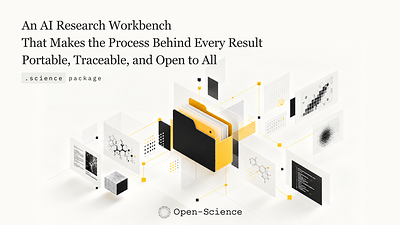

AIPOCH Launches Open-Science, Making Research Easier to Follow, Learn From, and Share with .science Packages
PR Newswire
SINGAPORE, Oct. 14, 2026
An open-source AI research workbench with 23 built-in Skills, 525 marketplace Skills, 36 research connectors, and four agent frameworks—Claude Code, OpenCode, Codex, and CodeBuddy.
SINGAPORE, Oct. 14, 2026 /PRNewswire/ — AIPOCH today announced the formal public release of AIPOCH Open-Science, an open-source AI research workbench designed to help more people explore questions with AI, understand how results are produced, and share the work behind them. The release highlights .science packages, which bring selected conversation branches, file versions, notebook records, and verification evidence together, making the research process easier to follow, learn from, and share. This model has broad applicability and may become a new paradigm in the agent era. Whether for collaboration between people or the replication of expert experience, .science is an answer built for the agentic data transportability.
AIPOCH Open-Science is available now under the Apache License 2.0. A preprint describing AIPOCH Open-Science is available at https://arxiv.org/abs/2610.17110. Beyond AIPOCH, the paper’s authors are affiliated with 76 institutions worldwide. These institutions include medical centers such as Zhongshan Hospital of Fudan University, Amsterdam UMC, and Beth Israel Deaconess Medical Center, a Harvard Medical School teaching hospital; universities such as Peking University, Shanghai Jiao Tong University, Zhejiang University, the University of Illinois Urbana-Champaign, and the Technion – Israel Institute of Technology; and technology and biotechnology companies such as SenseTime and Amoy Diagnostics. This breadth of collaboration shows that the AIPOCH Open-Science approach has been validated by many of the participating institutions. To learn more, visit https://aipoch.com/ or check the GitHub source at https://github.com/aipoch/open-science.
AIPOCH Open-Science brings AI agents together with research files, scientific literature, data sources, executable tools, local and remote computing resources, and research artifacts in one environment. Researchers can move from a research question to literature review, data analysis, visualization, reporting, and the preparation of a .science package without separating the reasoning interface from the working environment.
Open-Science covers the broader research workflow, providing an open-source environment where AI agents can work with scientific materials, execute computational tasks, and produce traceable research artifacts. .science packages support the preservation and transfer of the context behind that work, giving researchers a structured way to prepare projects for review, collaboration, handoff, and long-term archiving. AIPOCH Open-Science is informed by open standards such as RO-Crate, which describes research data, code, authors, licenses, and provenance together as a single exchangeable “research object.” This gives .science packages a portable, standards-based foundation, so that research context can be shared, reviewed, and archived across projects and institutions.
Addressing the Challenges of AI-Assisted Research
AI tools are increasingly used in scientific and technical work, but researchers still face several barriers to incorporating them into their workflows.
Scattered research context. AI-assisted research often requires transferring files and copying conversation histories separately, making the complete research context difficult to review, hand off, and build upon.
Fragmented workflows. Literature, PDFs, datasets, code, compute environments, notes, and final outputs live in disconnected tools. Researchers spend time moving across disconnected applications.
Vendor and model lock-in. Research teams may depend on a single provider or hosted environment. Organizations and individuals with self-developed or locally deployed models may also lack a flexible way to connect those models to research files, tools, and computing resources.
Opaque AI outputs. A polished answer or figure can be hard to evaluate when its source material, producing code, execution history, or intermediate decisions are missing.
Limited handoff and collaboration. Some AI research tools are designed primarily for individual use, which can make it difficult to share working context, hand off a project, or continue research across people and devices.
AIPOCH Open-Science addresses these challenges by making research context portable and inspectable through .science packages and a persistent workspace. A package can contain selected conversation branches, file versions, notebook records, and verification evidence. It can be shared with another researcher, moved to another computer, or imported as a read-only record for review. Researchers can fork it into a writable copy to build on the shared work.
Open-Science also brings the research workflow into a persistent, inspectable workspace, with support for multiple AI model providers and configurable execution environments. More than a research workbench, AIPOCH Open-Science works as a research operating system—a foundational environment where AI agents, models, data, tools, and computing resources operate together as parts of one coherent system. For instance, instead of switching between different tools at each stage of a project, users of AIPOCH Open-Science can access research capabilities in one unified workbench. Literature exploration, computational analysis, visualization, and reporting become connected steps in a single, coherent research process.
From Research Questions to Reproducible Artifacts
With AIPOCH Open-Science, users can describe a task in plain language and work with an AI agent to plan and execute research workflows. Subject to user permissions, agents can inspect research files, search approved sources, query scientific data connectors, and run Python, R, and shell workflows. The agent can create reports, tables, figures, notebooks, and other research artifacts that users can inspect and review.
Key capabilities include:
- Portable .science packages. Open-Science pioneers the sharing of recorded AI-assisted working processes between machines. A .science package preserves an AI-assisted research session in a portable format. It allows work done on one system to be opened, inspected, and continued on another. Users can export selected conversation content and branches, file and artifact versions, notebook records, available provenance, and verification evidence for sharing, inspection, handoff, continuation, and archiving across projects or computers. After import, the record opens in read-only mode; it does not automatically execute code, restore credentials, or reuse the original external-service authorizations. Users can fork the imported record into a new writable copy to continue working. Reproducing an original result still depends on whether the exported inputs, code, dependencies, runtime, execution records, and any required external data are complete and still available.
- Integrated literature library. Researchers can organize references and PDFs, use AI agents to search and read library materials, and generate formatted citations and bibliographies. Smart Collections can optionally use a configured classification model such as Jev to screen references against user-defined inclusion and exclusion criteria, helping users build a focused reading set while keeping the results available for human review. BibTeX and RIS import and export connect the library with existing reference workflows.
- Open-source and model-agnostic architecture. Open-Science supports multiple AI model providers, agent frameworks, compatible custom gateways, locally deployed AI models, reusable Skills, and scientific connectors. Users can configure different models for different tasks, matching each task with a model suited to its requirements and strengths. Its codebase is available under the Apache License 2.0.
- Integrated code execution. AI agents can run Python, R, and shell workflows directly, enabling them to perform computational tasks rather than simply recommend code.
- Traceable research artifacts. Reports, tables, figures, and notebooks are preserved as immutable versions, with available connections to inputs, producer code, execution history, environment details, conversation branches, and optional reviewer evidence.
- User-controlled infrastructure. Project data is stored locally by default. Users can configure access permissions and connect compatible locally deployed AI models or external services, subject to their respective configurations and requirements.
An Open Ecosystem for Scientific Capabilities
AIPOCH Open-Science includes the Skill Marketplace which currently offers 525 Skills, and the Specialist Marketplace which includes 10 Specialists. Both marketplaces support contribution and review processes, enabling users to discover and install research capabilities directly within the workbench. Skills provide reusable scientific methods and tools, while Specialists combine instructions, Skills, and data tools into AI assistants for specific research scenarios.
By inviting researchers and developers worldwide to contribute Skills and Specialists, Open-Science is building a global open-source community. The goal is to make research capabilities easier to discover, reuse, and extend across disciplines.
“The era of Vibe Research is coming, where more people can turn their curiosity and research ideas into meaningful work,” said Huimei Wang, CEO of AIPOCH. “AIPOCH Open-Science brings open research tools, reusable scientific methods, and AI capabilities together in one workbench. We hope to make scientific exploration more accessible and build an open ecosystem where researchers and developers can contribute to and benefit from one another’s work.”
Designed for Scientific and Technical Workflows
AIPOCH Open-Science is designed to give researchers greater control over their tools, infrastructure, and working environment.
AIPOCH Open-Science supports research and technical workflows across life sciences, bioinformatics, statistics, machine learning, chemistry, materials science, physics, and environmental science.
The workbench is designed for researchers, students, educators, developers, engineers, analysts, and anyone with a desire to explore with AI. It helps users form hypotheses, analyze data, run computational experiments, interpret evidence, and produce reproducible research artifacts.
About AIPOCH
AIPOCH is building an open ecosystem for AI-powered scientific research. By bringing together AI agents, scientific tools, reusable methods, and research infrastructure, AIPOCH aims to make scientific capabilities more accessible and enable researchers and developers around the world to explore, build, and share new ways of doing research. Learn more at: https://aipoch.com/.
 View original content to download multimedia:https://www.prnewswire.com/news-releases/aipoch-launches-open-science-making-research-easier-to-follow-learn-from-and-share-with-science-packages-302908207.html
SOURCE AIPOCH